Articles
How Does an Antique Music Box Work? Cylinders, Combs and Sound
Understand antique music-box mechanisms: wound springs, pinned cylinders, tuned combs, disc systems and orchestral effects, with collection photographs.

An antique music box creates music through physical contact and vibration. In a cylinder mechanism, a wound spring supplies energy, a pinned cylinder carries the musical sequence, and a tuned metal comb produces the notes. The music is made by the instrument as it runs; it is not a recording hidden inside a decorative cabinet.
The spring stores the energy
Winding a spring-driven music box stores energy for the mechanism to use. As that energy is released, a train of gears transmits motion to the working parts. Different instruments have different winding and control arrangements, so the operation of one example should not be assumed to apply to another.
The spring supplies the power rather than the melody. To understand where the tune comes from, look at the relationship between the moving cylinder and the comb beside it.
The cylinder carries a mechanical musical pattern
Small pins are arranged around the cylinder. As it turns, they lift and release selected teeth of the comb. Their positions determine which notes are triggered and when, turning a fixed physical pattern into a sequence heard over time.
Historical cylinder music boxes vary in their musical programmes. Some contain several tunes. The repertoire and selection arrangement belong to the particular mechanism; they cannot be established simply by counting decorative figures or looking at the cabinet.
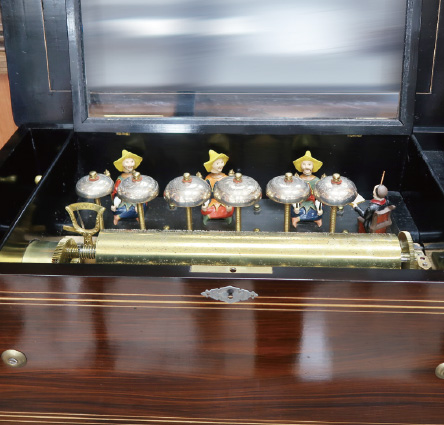
The comb is the source of the notes
The comb is a set of tuned metal teeth. When a tooth is plucked and released, it vibrates at its intended pitch. The cylinder organises the sequence, while the comb supplies the sounding notes. Both need to work together for the musical phrase to be heard as intended.
During a demonstration, follow one passage rather than trying to watch every component. Listen to the beginning of the phrase, the relationship between consecutive notes and the way a note fades. It is a simple way to connect what the mechanism does with what the ear hears.
Cylinder and disc music boxes are different systems
A cylinder box carries its musical pattern on a pinned cylinder. A disc music box uses a disc to carry the programme. Disc systems made it easier to replace the musical programme and expand the available repertoire. The outward appearance of a wooden cabinet alone does not identify which system is inside.
A music box should also be distinguished from other self-playing instruments. A moving figure or an elaborate cabinet may accompany a musical mechanism, but its presence does not tell you which component produces the sound.
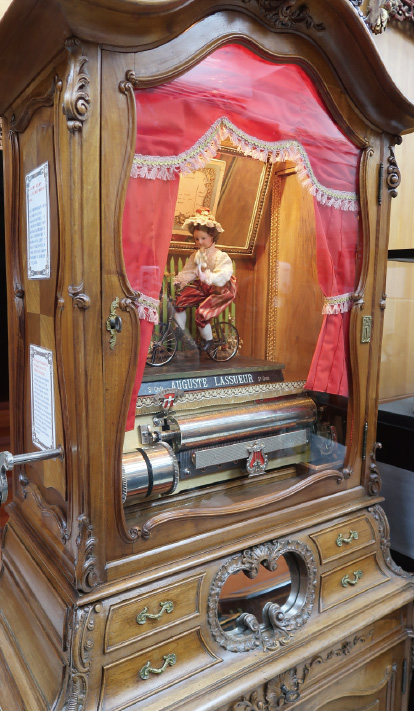
Why do some antique music boxes have bells and drums?
More elaborate historical instruments combine the comb with additional sounding parts. The Smithsonian documents orchestra music boxes equipped with combinations such as bells, a drum and organ pipes. Those elements add different kinds of sound to the musical arrangement.
This explains why two antique music boxes can offer very different experiences. They may differ not only in the tune played, but in the mechanism and the range of sounding components. The maker’s marks, tune information and visible construction are useful starting points for understanding an individual piece.
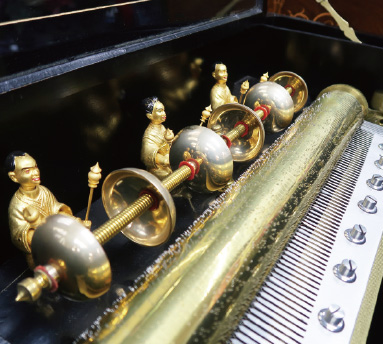
Understanding the mechanism makes preservation meaningful
The mechanism depends on small parts meeting in a precise sequence. Worn, damaged or incorrectly adjusted components can affect how it operates and sounds. Antique examples should therefore be handled by someone familiar with the instrument, with operation and repair guided by its condition rather than guesswork.
The appeal of preservation is that the object’s purpose can remain intelligible: a cabinet is not merely an attractive shell, and a cylinder is not merely an old piece of metal. Together with the comb and drive mechanism, they reveal how craftsmanship can turn stored energy into music.

Questions and answers
Where does a music box’s sound come from?
In a cylinder music box, the pins pluck tuned metal comb teeth. Their vibration creates the notes.
Can every music box play different tunes?
No. The musical programme and any tune-selection system depend on the individual mechanism.
Is a disc music box the same as a gramophone?
No. A mechanical musical box actuates sounding parts; a gramophone reproduces recorded sound.
See the mechanism behind the melody. Ask about the antique music-box collection when arranging a private viewing at Memorigin’s Hong Kong showroom. Demonstrations are subject to the instrument’s condition and the confirmed appointment arrangements.